

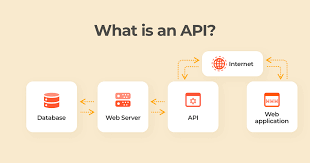
An Application Programming Interface (API) is a set of protocols, routines, functions, or commands that programmers use to develop software or facilitate interoperability between different systems. The API is a powerful and versatile tool for combining different and different software applications. APIs allow many unrelated software products to integrate and work with other programs and data.
APIs are available for both desktop and mobile use, and are typically useful for programming GUI (graphical user interface) components, as well as allowing an application to request and deploy services from another application.
Simply put, we call a structure API a structure that allows us to use the properties of application A in application B. For example, by calling the API for http://www.iamaqa.tech.blog (or application) from http://www.cnn.com (or application), we can perform all the operations supported on cnn.com on http://www.iamaqa.tech.blog. You use the API every time you use an app like WhatsApp, send an instant message, or check the weather on your phone.
During this period of use, you can receive or send the allowed features, functions and content without the need for the application itself. Of course, most entries have certain restrictions and are logged. In addition, you must use the login information provided to you by the application you want to access for the operations you want to perform.
How does the API work?
For example, when you use the application on your mobile phone, the application connects to the Internet and sends the data to the server. The server then receives this information, interprets it, performs the necessary actions and sends it back to your phone. The application then interprets this information and presents the information you want in a readable way. This is the API. All this happens through the API.
To better explain this, let’s use an analogy from everyday life, as shown in the figure:
Imagine you are sitting at a table in a restaurant with a menu that you can order. The kitchen is part of the “system” that will prepare your order. What is missing is a critical connection that will take your order to the kitchen and bring your food back to your table. This is where the waiter or API enters the image. The waiter – or API – is the intermediary who accepts your order and tells the kitchen – the system – what to do. Then the waiter sends you the answer; In this example, the answer is your food and drink.
Types of APIs?
APIs are widely accepted and used in web applications. There are four main types of APIs commonly used in web-based applications: public, partner, private, and composite. In this context, the API “type” indicates the intended use area.
Public API (also known as Open API): The Public API is open to anyone and can be used by any developer or enterprise. Open APIs or Public APIs have no limitations and can be developed by many developers over time. Although they are secure, anyone can access, add and change the mechanisms. Public APIs typically cover intermediate level of authentication and authorization. An enterprise can also try to make money from the API by setting a price for each call to use the public API.
Internal API (also known as Private API): Private APIs or Internal APIs are only available for internal systems. You need special rights or licenses to use this type of API. These APIs are usually well protected behind firewalls and company protocols because they store important company information that is not publicly available. For example, the Internal API can integrate an organization’s payroll and HR systems.
API Partners: Partner APIs are used to collaborate with business partners. Partner APIs are not publicly available, but like Internal APIs, they are only available to certain user groups through authentication and authorization mechanisms. However, unlike Internal APIs, Partner APIs operate outside the company and therefore require additional security measures.
Composite API : As the name suggests, Composite APIs combine different data and service APIs to create the result the developer wants. Instead of being run by a single task, Composite APIs work sequentially according to execution. This type of API speeds up the process and increases user interaction.

 I am Magas